 |
|
|
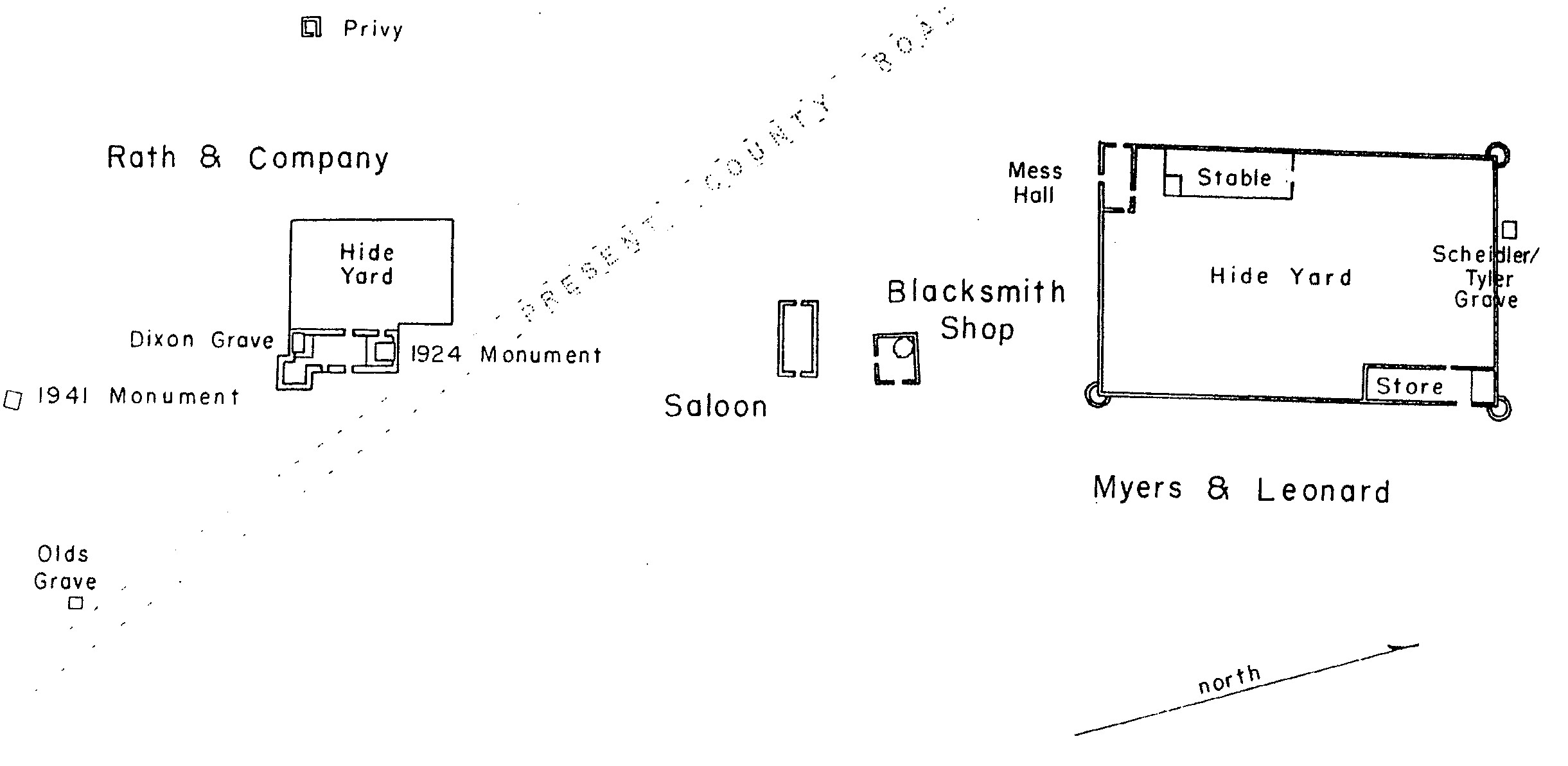
General plan of the 1874 Adobe Walls trading post site.
~*~
Your visit to the 1874 Adobe Walls Battleground
by Dr. T. Lindsey Baker
On June 27, 1874, an estimated 200 warriors from the Comanche, Kiowa,
and Southern Cheyenne tribes attacked an estimated 30 buffalo hunters,
skinners, and storekeepers at a trading post on the north side of the Canadian
River in the Texas Panhandle. The fight which ensued resulted in
losses on both sides, but constituted a stand-off. Neither side won.
Within a matter of a few days, the traders abandoned their 2 stores,
saloon, a blacksmith shop, returning with their goods to Dodge City, Kansas.
The incident however, served as the spark which brought on the Red
River War of 1874-75 between the U.S. Army and the Southern Plains tribes.
This last major military campaign on the Southern Great Plains led to the
surrender of the nomadic warrior and their permanent settlement on reservations
in present day Oklahoma. Within a year, the first Euro-American ranchers
had begun occupying the former buffalo range on the Southern Great Plains,
beginning the era of the "Cattle Kingdom".
The Native Americans attacked the buffalo hunters' trading post on
the Canadian River because they were exterminating their commissary--the
bison. As nomadic hunters, the native people had subsisted on the
bison for many years. They depended on the animals for food, clothing,
and shelter. Without the bison they could no longer roam the plains.
Commercial big-game hunters had begun slaughtering bison for their
skins in the winter of 1871-72 after tanneries had developed new methods
for converting dried bison skins into usable leather. Up to this
time, raw buffalo skins had been virtually worthless to Euro-Americans.
With a hitherto new market, hundreds of men flocked to the plains of Southwestern
Kansas to kill vast numbers of buffalo for their hides only. After
the Kansas herds had been decimated, they turned their attention to the
herds remaining in the Texas Panhandle. Merchants followed the hunters,
establishing a trading post at Adobe Walls in spring 1874.
The trading post consisted of the Rath & Company Store which was
constructed of sod, Charles Hanrahan's' Saloon, also built of sod, Tom
O'Keefe's blacksmith shop, constructed of wooden log pickets set
vertically in the ground, and the Myers & Leonard Store Complex, also
built of pickets with added mud daubing. Here, about 30 white men
and one woman defended themselves from attack in the stand-off fight on
the morning of June 27, 1874.
A few days after the fight, the Kansas merchants removed their goods
to Dodge City, abandoning the Adobe Walls site due to continuing hostility
from the Southern Plains tribes. Warriors burned the buildings in
August of 1874, and the site remained abandoned except for occasional memorial
ceremonious in the 1920's to 1940's. Archaeologist Billy R. Harrison
began a systematic excavation of the site in 1975. Spending a total
of 11 years excavating the site and analyzing the artifacts recovered,
Harrison collaborated with Dr. Baker in writing a 413 page book on the
Adobe Walls site entitled Adobe Walls: The History and Archeology of
the 1874 Trading Post published by the Texas A&M University Press
in 1986.
Today, Adobe Walls is an archeologist site owned by the Panhandle Plains
Historical Society. It consists of historical markers, graves, low earthen
mounds marking the sites of several buildings, and subsurface archaeological
materials. It is protected by both state and federal statutes.
 |